Venturing into Substack
By way of introduction

This is by way of introduction. Of me to Substack which is currently a slightly strange new world, so bear with. And of anyone who may be reading this, to me.
I’ve been on something of a transitional journey these last 7 months having resigned my paid employment to give proper time to discern what’s next. I should say that I resigned after 16 and a half years as a pioneer minister in the Church of England, exploring with others creative ways to be the church in our contemporary culture. In the course of that experience I’ve found myself giving more and more time to reflecting on that experience, and then writing about it. Most recently I’ve been working toward a doctorate in theology looking the ecclesiology of pioneer ministers in the CofE. More of that perhaps at some point.
What has been dawning on me - a sun that I has defied gravity underneath a personal horizon of my own stubbornness - is a call to be a writer. To admit I am creative and that that’s not something that has to be confined to the fringes of my vocation when all the other important stuff is done. To embrace writing as a gift, communication as a craft and a vocation. So, having left X like so many of us, I am venturing into Substack as a way of engaging with anyone who might find what I have to say helpful, and as a way of staying accountable to my calling.
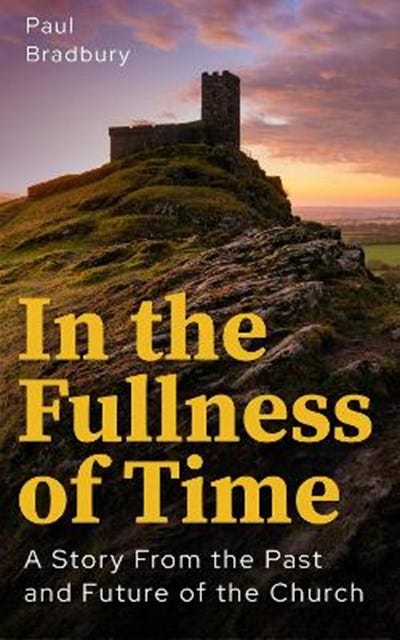
It is nearly a year now since I published my last book - called In the Fullness of Time (Canterbury Press 2024). That book was an attempt set out some of my thinking about the future of Christian witness (I use that term rather than the church for reasons that perhaps I’ll come onto at some point), particularly in a rural context. I grew up in a small insignificant village in north Dorset. The kind of place you spend much of your childhood looking forward to escape from, only to find that it gave you far more than your ever realised or appreciated at the time. I guess I’m at that point in life. A point that was highlighted by the news a few years ago that the church in that village had closed. News about the death of the rural church has on the whole been exaggerated it seems. Perhaps until now, post-Covid, and then very personally for me. I never went to that church. That whole world was alien to me growing up. And yet the news of the death of that church impacted me to the extent that I began to explore what possibilities their might for other such villages, and for the future of Christian witness in rural areas more generally.
So In the Fullness of Time evolved from the experience. It was the fruit of a journey to other rural churches, some very traditional others more experimental. I figured I might start this Substack by summarising in shortened format some of thinking that emerged from that project. So I will doing this over the next few weeks. Perhaps with the odd interlude for other things that crop up. That seems a good way to begin, not just as a way of celebrating a year since publication, but because it also does a good job of giving an overview of some of the themes I am thinking about and exploring more generally.
To provide a brief summary of those themes here I’d say; that I sense that the Christian community in the west in particular is experiencing a decentering and a disruption of what it has assumed to be normative for centuries. Christendom is ending. Modernism is ending. Mainstream denominations are facing an ending. And there is no real sense of what in any concrete terms is emerging to replace it all. There is a great anxiety associated with this, in terms of our concern for institutions as well as more existential concerns about the future. I guess my concern has so far been more about being faithful to the call to be communities of Christian witness in the midst of this time of upheaval, or as some have called it a ‘time of endings’.
In 2020 as the Covid virus swept through Europe, a week before the UK went into lockdown, I spent a week in Northumberland within view of Lindisfarne. The history of that edgy place is rooted in another epochal crisis. The viking raids from across the north sea represented a dark and anxious time for the people of the north and for the Christian community there. In this context the likes of Cuthbert and Aidan reimagined the witness of the church in their day. There is a statue of St Aidan at the abbey on Lindisfarne. A tall and striking figure, large than life, really quite imposing, with a strong hand gripping a tall staff, stares into the distance with a stance as if ready to venture into the unknown. Looking at this statue in that week I felt I heard the words ‘renew my witness’. This is what I have tried to do through ministry, through teaching, training, supporting others, and through writing. Thanks for reading. I hope perhaps you’ll read more as things develop.